


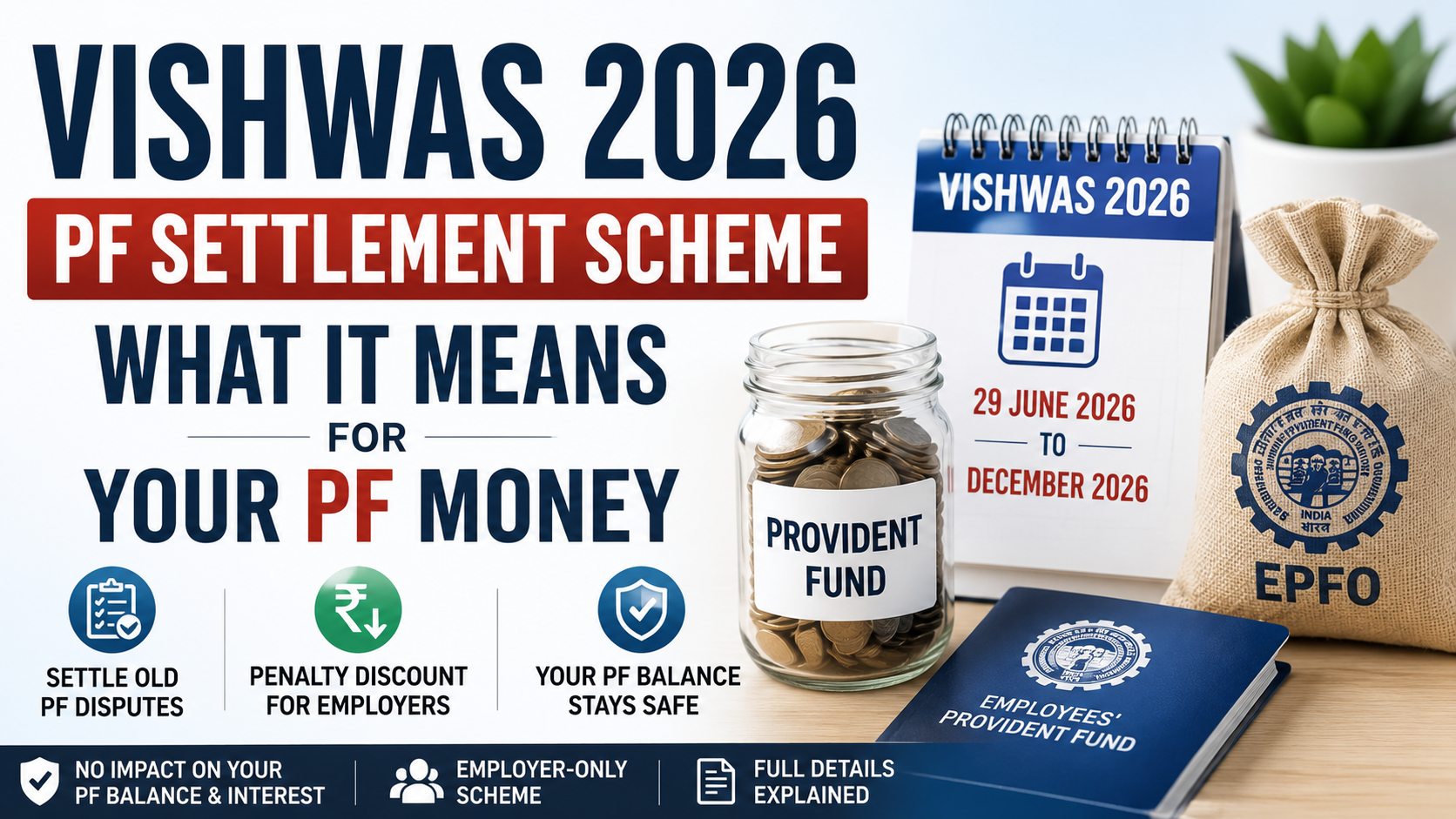
If you’ve spotted the term “VISHWAS 2026” while scrolling PF news and felt a small jolt of worry — is my provident fund about to change, is my money at risk, do I need to do something — take a breath. This one’s not about you, and this article will tell you exactly why, in plain language, with real numbers.
What Is VISHWAS 2026, in Plain Terms?
VISHWAS 2026 is a six-month window — running from June 29, 2026 to late December 2026 — during which employers can settle old PF penalty disputes with the EPFO at a discount, instead of dragging them through court for another five years.
Here’s the backstory in one sentence: when an employer deposits your PF contribution late, EPFO doesn’t just ask them to pay up — it fines them. That fine is called a “damage” under Section 14B of the EPF Act (or Section 128 if the employer falls under the newer Social Security Code, 2020). Many employers disputed these fines and ended up stuck in litigation for years. VISHWAS 2026 is EPFO’s way of saying: settle now at a lower rate, and we’ll both move on.
Notice what’s missing from that description — your account, your balance, your interest. That’s because this scheme lives entirely on the employer’s side of the ledger. You’re not applying for anything. You don’t need to do anything. But understanding it still matters, because “PF” and “penalty” in the same sentence tends to spook people, and you deserve a straight answer instead of vague reassurance.
Why EPFO Launched This Scheme
The numbers explain the “why” better than any policy statement could. As of May 2025, EPFO had over ₹2,400 crore in outstanding penal damages tied up across more than 6,000 pending cases in courts and tribunals — with another 21,000 potential cases sitting in EPFO’s e-proceedings pipeline, not even litigated yet.
Think about what that actually means in practice. A single 14B dispute can sit in a Central Government Industrial Tribunal or High Court for years, racking up legal fees on both sides, while the underlying question — did the employer really owe this fine — remains unresolved. EPFO doesn’t collect a rupee during that time. The employer doesn’t get closure. Nobody wins except the lawyers.
Old penalty rates made this worse. Damages ranged from 5% to 25% per annum depending on how late the payment was, and for delays before 2008, rates were even steeper — 17% to 37% annually. At those rates, an employer facing a genuinely disputed fine had every incentive to fight it out in court rather than pay, even if fighting cost more in legal fees over time. VISHWAS 2026 flips that math: it offers a number low enough that settling becomes cheaper than continuing to fight.
The name itself is the pitch — “Vishwas” means trust in Hindi. EPFO is betting that a fair, one-time discount will rebuild enough goodwill that employers choose to close old disputes and stay compliant going forward, rather than treat every fine as a fight worth having.
Does VISHWAS 2026 Affect Your PF Balance or Interest?
No. Your accumulated PF balance, the interest already credited to your account, and your pension eligibility are completely untouched by this scheme. This is the single most important thing to know, so let’s spell out exactly why.
VISHWAS 2026 only discounts one thing: the penalty an employer owes to EPFO for depositing your contribution late. It does not touch the contribution itself, and it does not touch the interest on that delayed contribution either. That interest — calculated under Section 7Q of the EPF Act — has to be paid in full, no discount, before an employer can even apply for the scheme. So the two things that would actually affect your account (the principal contribution and the interest on it) are both fully protected. The only thing getting a haircut is the fine EPFO charges the employer as a deterrent.
Here’s a quick myth-vs-fact table to make this concrete:
| Myth | Fact |
|---|---|
| My PF interest will be reduced under this scheme | Untouched — interest must be paid in full before an employer can even apply |
| My PF balance could shrink because of this | No — your contribution amount was never part of the “penalty” being discounted |
| I need to opt into or apply for VISHWAS 2026 | No — it’s an employer-only application; there’s nothing for you to submit |
| This changes how my pension is calculated | No — pension eligibility runs on your actual contribution history, which this scheme doesn’t alter |
A real-world example: Say a mid-sized manufacturing firm deposited a batch of employee PF contributions eight months late back in 2022, and EPFO slapped a 14B penalty on them for it. The firm disputed the fine and it’s been sitting in a tribunal since. Under VISHWAS 2026, that firm can now pay the full 7Q interest on the delayed deposit (so employees lose nothing there), pay a reduced penalty amount instead of fighting the case for another three years, sign an undertaking to drop the appeal, and close the matter. The employees whose contributions were delayed back in 2022? Their money and interest were credited exactly as owed — this scheme changes nothing about what lands in their account. It only changes how quickly and cheaply the employer’s legal headache gets resolved.
Who Actually Benefits — Employers, Employees, or EPFO?
Let’s be honest about this instead of pretending everyone wins equally, because that’s usually not true with schemes like this.
Employers are the clear, direct beneficiary. They get to close expensive, years-old disputes at a fraction of the original penalty, avoid ongoing legal costs, and walk away with certainty instead of an open-ended court case.
EPFO benefits too — it recovers money it might otherwise wait years to see (or never see, if a case drags on indefinitely), and it clears a backlog of thousands of pending matters clogging up tribunals and courts.
Employees get an indirect, softer benefit. There’s no cheque coming your way. But there’s a reasonable case that an EPFO with less litigation backlog and employers with cleaner compliance records makes the whole system function better — employers who settle old disputes and start fresh have less reason to let future contributions slide, and EPFO’s resources aren’t tied up defending old cases instead of processing new claims and services. It’s a real benefit, just not one you’ll see reflected in your passbook.
If you’re looking for the honest one-line answer to “who benefits”: employers benefit financially, EPFO benefits operationally, and employees benefit structurally — a healthier system around their money, not more money itself.
How Do I Know If My Employer Has a Pending PF Penalty Case?
You won’t get a direct notification if your employer is party to a 14B dispute — that’s a matter between the employer and EPFO. But there are a couple of practical ways to get a sense of it.
Open your UAN passbook and look at the contribution timeline. If you notice recurring gaps — say, your employer’s contribution consistently lands 15-20 days after your salary date instead of on time — that’s the kind of pattern that generates 14B disputes in the first place. It doesn’t confirm litigation, but it’s a signal worth paying attention to.
If the delays look chronic and it’s bothering you, you can raise it through EPFO’s grievance portal (EPFiGMS). You won’t get details of any ongoing legal case — that’s not public information — but you can flag concerns about your own contribution timeline and get a response from EPFO directly.
Key Dates and Eligibility Snapshot
For anyone who wants the reference details without digging through the notification:
- Window: June 29, 2026 to late December 2026 (six months)
- What qualifies: Disputes under Section 14B (EPF Act) or Section 128 (Social Security Code, 2020) — this includes cases still in litigation before tribunals or courts, finalized orders that haven’t been paid yet, and cases where a notice has been issued but no final order exists yet
- Non-negotiable condition: The employer must pay the full interest liability (Section 7Q / Section 127) before the discounted penalty applies
- Legal trade-off: Once settled, the employer must withdraw any pending appeal and give an undertaking not to reopen the same dispute later
- Already-paid amounts: If an employer already paid more than the newly discounted penalty, they don’t get a refund of the difference. If they paid less than the discounted amount, they only owe the shortfall.
None of these conditions involve or require any action from you as an employee — they’re listed here purely so you understand what your employer (or your company’s HR/finance team, if you’re curious enough to ask) is actually navigating.
Frequently Asked Questions
Will VISHWAS 2026 reduce my PF interest? No. Only the employer’s penalty is discounted. Interest owed to your account must be paid in full before an employer can even use the scheme.
Do I need to apply for anything as an employee? No. This is strictly an employer-to-EPFO settlement process. There’s no employee-facing application or form.
How long is the scheme open? Six months, from June 29, 2026 through late December 2026.
What happens to my PF if my employer chooses not to settle under VISHWAS? Nothing changes for you either way. Your contribution and interest obligations are separate from whether your employer settles or continues litigating a penalty dispute.
Is this the same as a PF withdrawal scheme? No — and this mix-up happens a lot because both involve the word “scheme.” VISHWAS 2026 is about employer penalty settlements, not about withdrawing your own PF money. If you’re looking for withdrawal rules, that’s a completely different EPFO process.
The short version: VISHWAS 2026 is EPFO clearing out years of legal backlog by giving employers a reason to stop fighting and start settling. It’s a good-news story for the system, a genuinely useful one for employers sitting on old disputes — and, for you as a PF holder, a total non-event as far as your actual balance is concerned. Worth knowing about, not worth losing sleep over.

