


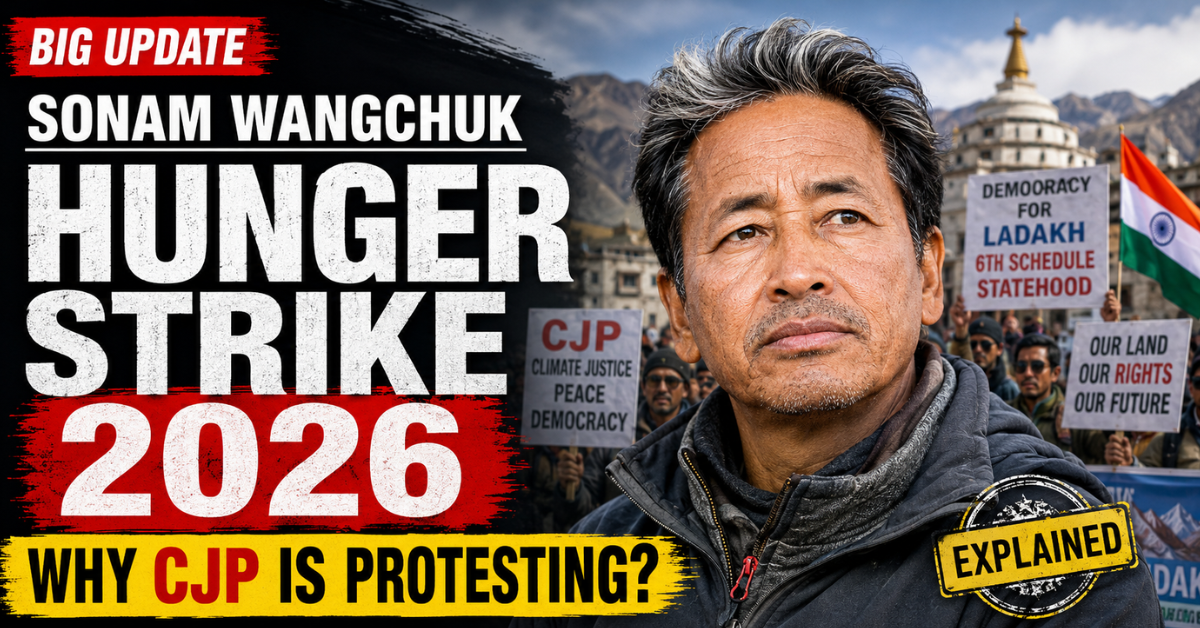
The Sonam Wangchuk hunger strike 2026 entered its 20th day in New Delhi on 17 July 2026, raising serious concerns about the activist’s health. Wangchuk is fasting in support of the youth-led Cockroach Janta Party, or CJP, which is demanding accountability over alleged examination irregularities and wider reforms in India’s competitive-examination system.
This Gyan Mela explainer examines why Sonam Wangchuk began the hunger strike, what the Cockroach Janta Party represents, the movement’s demands and what could happen during the proposed Parliament march.
Key Takeaways
- Sonam Wangchuk began his indefinite hunger strike on 28 June 2026.
- The fast entered Day 20 on 17 July, with reports saying that he had lost more than 9 kg.
- He is supporting the Cockroach Janta Party’s campaign over examination accountability and reform.
- The protesters are demanding Union Education Minister Dharmendra Pradhan’s resignation.
- They also want broader examination reforms and a discussion in Parliament.
- The Delhi High Court directed authorities to monitor Wangchuk’s health.
- A peaceful march towards Parliament has been proposed for 20 July 2026.
Sonam Wangchuk Hunger Strike 2026: Latest Update
Sonam Wangchuk’s indefinite hunger strike reached its 20th day at Jantar Mantar on 17 July 2026. According to the doctor monitoring his condition, he had lost more than 9 kg after surviving only on water during the protest.
Despite his weakening physical condition, Wangchuk said that he remained mentally determined to continue the campaign. He also expressed his intention to remain part of the proposed peaceful march towards Parliament on 20 July.
Medical professionals have warned that continuing a prolonged water-only fast may lead to serious health complications, including muscle loss, electrolyte imbalance and damage to vital organs.
The Delhi High Court became involved after concerns were raised about his deteriorating condition. The court directed the authorities to monitor Wangchuk’s health and intervene according to medical advice if his condition became critical.
Why Is Sonam Wangchuk on Hunger Strike?
Sonam Wangchuk joined the protest in solidarity with students and young people associated with the Cockroach Janta Party.
The movement is demanding accountability over alleged irregularities connected with NEET-UG 2026 and recurring concerns about competitive-examination leaks and mismanagement.
Wangchuk has argued that the resignation of one minister should not be the movement’s only objective. According to him, political accountability should be followed by wider reforms in the examination and education systems.
He has also called for the issue to be discussed during Parliament’s Monsoon Session.
The protest reflects a wider concern among Indian students: when admission to medical colleges, universities and government employment depends on highly competitive examinations, even one serious irregularity can affect lakhs of candidates and their families.
What Is the Cockroach Janta Party?
The Cockroach Janta Party is a youth-led satirical protest movement founded by Abhijeet Dipke.
The movement began online in May 2026 and later organised physical demonstrations concerning unemployment, educational pressure, examination irregularities and government accountability.
Despite using the word “party” in its name, it is not described as a conventional registered political organisation. It operates more like an informal youth movement in which supporters organise themselves and participate in demonstrations.
The abbreviation commonly used for the movement is CJP.
Why Is It Called the Cockroach Janta Party?
The movement’s unusual name reportedly originated from a controversial courtroom remark in which some unemployed young people were compared to cockroaches.
Young social-media users reclaimed the insult and turned the cockroach into a symbol of survival and resilience.
The name is deliberately satirical. It reflects the feeling among many young Indians that they are repeatedly ignored but continue struggling despite academic, financial and employment pressures.
What began as an online joke gradually developed into a broader protest movement.
What Are the Protesters Demanding?
The demands of the Cockroach Janta Party are not limited to conducting another examination. The movement is seeking wider political and institutional accountability.
- Resignation of the education minister: Protesters are demanding that Union Education Minister Dharmendra Pradhan accept political responsibility.
- Examination reform: They want stronger systems to prevent leaks, impersonation and other irregularities.
- Parliamentary discussion: CJP wants the examination crisis and student concerns to be discussed in Parliament.
- Student participation: The movement wants students, young people and education specialists to be included in the reform process.
- Support for affected families: Organisers have sought assistance for families of students whose deaths they associate with examination pressure or disruption.
- Transparent accountability: The movement wants clear responsibility to be fixed whenever a large examination fails.
These are the protesters’ stated demands. They should not be confused with confirmed government decisions or established findings about individual responsibility.
What Happened With NEET-UG 2026?
The National Testing Agency originally conducted NEET-UG 2026 on 3 May 2026.
More than 22 lakh candidates were expected to appear for the medical entrance examination at centres across India and selected international locations.
The NTA later announced that the examination would be reconducted nationwide. The new examination was held on 21 June 2026, and candidates were not required to pay an additional examination fee.
The NTA also introduced a process for refunding fees associated with the original test.
Fresh NEET-UG 2026 scorecards were released on 16 July 2026. This means the admission process moved forward, even though the political debate about accountability and examination reform continued.
| Event | Date |
|---|---|
| Original NEET-UG examination | 3 May 2026 |
| Cockroach Janta Party movement emerged | May 2026 |
| CJP sit-in began | 20 June 2026 |
| NEET-UG re-examination | 21 June 2026 |
| Sonam Wangchuk joined the hunger strike | 28 June 2026 |
| NEET-UG scorecards released | 16 July 2026 |
| Hunger strike entered Day 20 | 17 July 2026 |
| Proposed Parliament march | 20 July 2026 |
What Has the NTA Done?
The National Testing Agency announced several security and administrative measures before and after the examination controversy.
These included:
- Biometric authentication of candidates
- Stronger monitoring at examination centres
- Measures against impersonation
- Action against online channels circulating fake question papers
- A nationwide re-examination
- Fee-refund arrangements
- Release of revised scorecards
These steps addressed the immediate academic process. However, CJP supporters argue that conducting another examination does not fully resolve questions about responsibility, student stress or long-term reform.
This distinction matters. The re-examination is an officially confirmed fact. Allegations about who caused a leak or the complete scale of wrongdoing require official investigative or judicial findings.
What Has the Government Said?
As of 17 July 2026, protest organisers said they had not received the direct political engagement they were seeking.
The NTA has issued notices, reconducted the examination, arranged refunds and released fresh results. However, those administrative actions are different from accepting the protesters’ demand for the education minister’s resignation.
Wangchuk has said that the movement is not associated with one fixed political ideology. He has stated that representatives from all political parties, including the ruling party, are welcome to engage with the protesters.
Why the 20 July Parliament March Matters
The Cockroach Janta Party has proposed a peaceful march towards Parliament on 20 July 2026, when the Monsoon Session is scheduled to begin.
The purpose is to bring examination reform, youth frustration and political accountability directly to the attention of elected representatives.
The proposed march may increase political pressure on the government. However, the final route, timing and arrangements may depend on police permissions and security restrictions around Parliament.
People planning to attend should verify information through official organiser announcements and local police advisories instead of relying on unverified social-media posts.
Why Sonam Wangchuk’s Health Became a Legal Issue
A prolonged hunger strike can cause serious medical complications.
When the body stops receiving food, it initially consumes stored carbohydrates and fat. Over time, it may begin breaking down muscle tissue. Electrolyte imbalance and dehydration can also affect the heart, kidneys and other organs.
Wangchuk’s doctor warned that his body was consuming fat and muscle reserves and that further deterioration could damage vital organs.
The Delhi High Court’s intervention attempted to balance two concerns:
- Wangchuk’s right to participate in a peaceful protest
- The authorities’ responsibility to prevent a life-threatening medical emergency
The court did not simply direct immediate force-feeding. It asked authorities to monitor his condition and act according to medical advice.
Why the Movement Has Connected With Young Indians
Competitive examinations play an enormous role in the lives of Indian students.
A single examination can determine whether a candidate secures admission to a medical college, receives a government job or gains access to a preferred university course.
Preparation may require years of study, coaching fees, relocation and considerable emotional pressure.
The Cockroach Janta Party has connected with young people because it combines several concerns:
- Fear that genuine preparation may be undermined by malpractice
- Repeated disruption of major examinations
- The financial cost of appearing for another test
- Limited education and employment opportunities
- Pressure on students’ mental health
- A belief that institutions rarely accept responsibility
The movement’s growth also demonstrates how humour and satire can turn into political mobilisation.
At the same time, a large online audience does not always translate into equally large participation at physical demonstrations. Digital support and on-ground mobilisation should be assessed separately.
How Examination Irregularities Affect Students
Financial cost
Candidates may spend money on application fees, coaching, travel, accommodation and study material. A cancelled or reconducted examination can increase these expenses.
Loss of preparation time
Students may have to extend preparation for several weeks or months instead of moving to the counselling or admission stage.
Mental-health pressure
Uncertainty about results and examination validity can create anxiety, sleep problems and emotional exhaustion.
Loss of confidence
Repeated irregularities can reduce trust in examination agencies and make students question whether honest preparation is sufficient.
Delayed academic schedules
Re-examinations may affect result dates, counselling rounds, admissions and the beginning of academic sessions.
What Readers Should Verify Before Sharing Updates
- Check the publication date because the protest is developing rapidly.
- Separate protesters’ allegations from facts confirmed by the NTA, courts or investigating agencies.
- Use the official NEET website for results and examination notices.
- Avoid sharing unverified medical claims about Wangchuk.
- Check police and organiser notices before relying on march routes.
- Do not mistake parody pages for official CJP accounts.
- Avoid forwarding old videos as footage of the current protest.
Frequently Asked Questions
Why is Sonam Wangchuk on hunger strike in 2026?
Sonam Wangchuk is fasting in solidarity with the Cockroach Janta Party’s campaign demanding accountability over alleged NEET examination irregularities. The movement is also seeking the education minister’s resignation and broader reforms in India’s competitive-examination system.
What is the Cockroach Janta Party?
The Cockroach Janta Party is a youth-led satirical protest movement founded by Abhijeet Dipke. It began online and later organised demonstrations concerning examination integrity, unemployment, education and government accountability.
Why is it called the Cockroach Janta Party?
The name reportedly originated after a courtroom remark compared some unemployed young people to cockroaches. Young activists reclaimed the term and used it as a symbol of resilience, survival and frustration with established institutions.
What are the main demands of CJP?
The movement is demanding Education Minister Dharmendra Pradhan’s resignation, accountability over examination irregularities, stronger examination safeguards, parliamentary discussion and support for affected students and families.
What happened with NEET-UG 2026?
The original examination was held on 3 May 2026. NTA later conducted a nationwide re-examination on 21 June and released new scorecards on 16 July. Questions about political and institutional accountability remain part of the ongoing controversy.
What did the Delhi High Court say about Wangchuk’s fast?
The court directed the authorities to monitor his health and intervene if medical advice showed that his condition was deteriorating. The direction followed concerns that the prolonged water-only fast could become life-threatening.
When is the Cockroach Janta Party Parliament march?
The proposed peaceful march towards Parliament is scheduled for 20 July 2026. The final route, permissions and timings may change, so participants should verify the latest official information.
Conclusion
The Sonam Wangchuk hunger strike 2026 has turned the Cockroach Janta Party’s youth campaign into a national discussion about examination integrity, political accountability and student pressure.
The NTA has already reconducted NEET-UG 2026 and released revised results. The unresolved question is whether these administrative actions will be followed by wider institutional reforms and political accountability.
The immediate concern remains Wangchuk’s health, while the proposed Parliament march on 20 July could become the movement’s next major moment.
Gyan Mela readers should follow verified news reports, official NTA notices, court developments and police advisories while avoiding unconfirmed claims circulating on social media.
Author: Gyan Mela Editorial Team

