


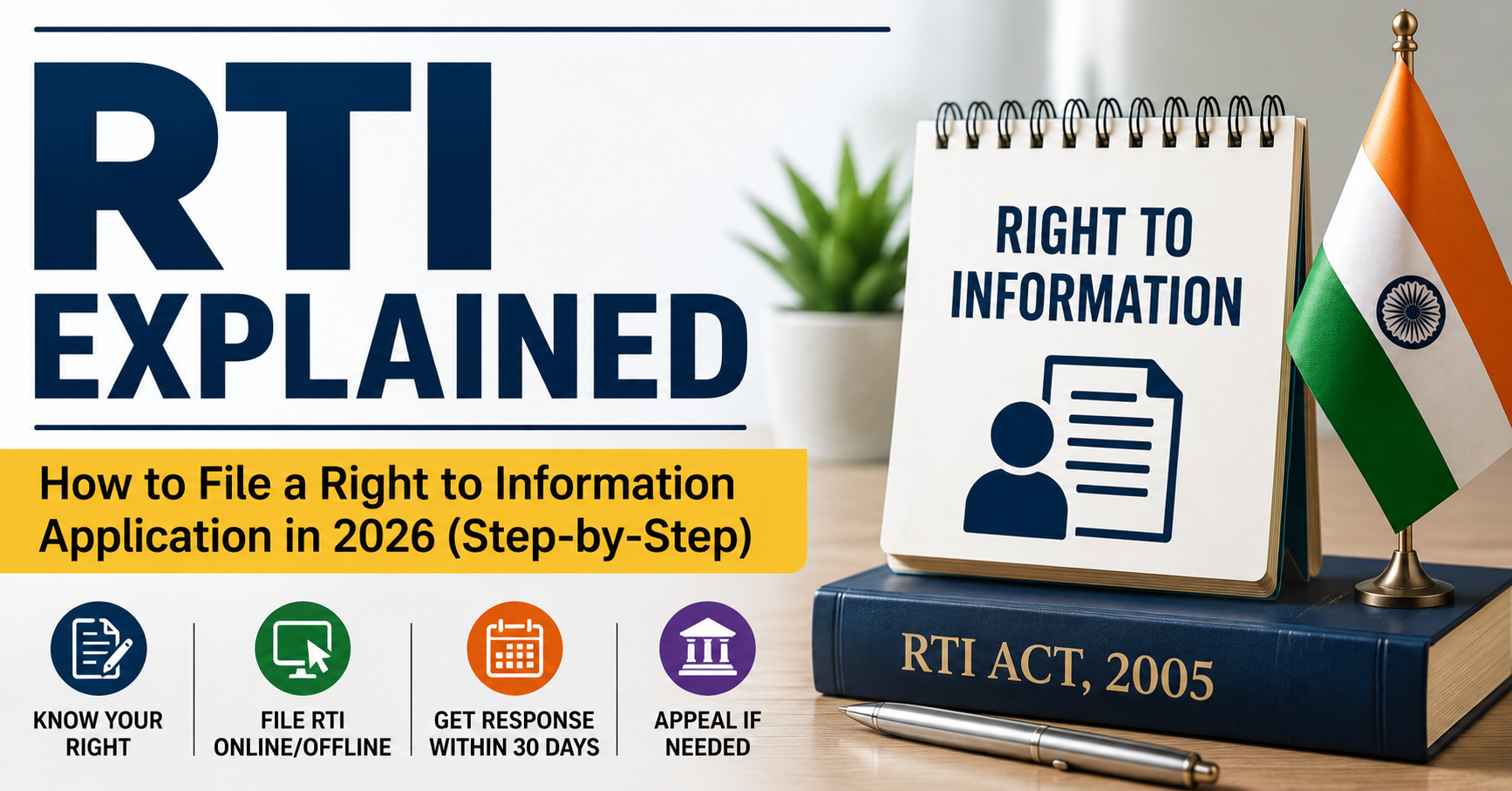
Most people hear “RTI” and think of it as some kind of legal weapon reserved for journalists and activists. It isn’t. It’s a tool any Indian citizen can use to make a government office answer a specific question — and once you know how it actually works, it stops feeling intimidating and starts feeling useful. This guide covers exactly that: what RTI is, how to file one correctly, and what happens when you do.
What Is RTI, Really?
RTI stands for Right to Information — a 2005 law that lets any Indian citizen formally ask a government body for information, and legally obligates that body to respond within a fixed time.
That last part is the whole point, and it’s worth sitting with for a second. Before this law, “please tell me why my road project is delayed” was a request you could make and a government office could simply ignore. After RTI, that same question becomes something they’re legally required to answer — with a real deadline, and real penalties if they don’t. That shift, from asking nicely to asking with legal backing, is what makes RTI genuinely different from writing a complaint letter.
It applies to central and state government departments, public sector undertakings, and — this is the part most explainers skip — private bodies that are substantially funded or controlled by the government. If a school runs largely on a state education grant, or an NGO gets most of its budget from a government scheme, RTI can reach it. What it doesn’t reach: a purely private company that isn’t funded or controlled by the government, no matter how much public interest there is in what they’re doing.
Who Can File an RTI, and What Can You Actually Ask For?
Only Indian citizens can file. No exceptions for NRIs without proof of citizenship, and you can’t file on behalf of a foreign entity.
Here’s something that surprises first-timers: you don’t have to explain why you want the information. The law doesn’t ask for a reason, and a PIO (Public Information Officer) can’t reject your request just because your motive seems unclear or even confrontational.
“Information” covers more than most people assume — documents, records, emails, circulars, memos, samples, and data held electronically. A few real examples of what people actually use RTI for: checking why a passport application has been stuck for two months, asking for the sanctioned budget and progress report on a stalled local flyover project, requesting your own answer sheet and marks breakdown from a public exam, or finding out how much a municipal corporation spent on a specific tender. You can also request to physically inspect records instead of just requesting copies — a right that exists but rarely gets mentioned.
Central vs. State RTI — Why the Portal You Use Matters
This is where a lot of guides quietly mislead people by talking as if there’s one universal RTI process. There isn’t.
rtionline.gov.in, the portal most people land on, only handles requests to Central Government Ministries, Departments, and a defined list of Central Public Authorities. If you want information from a state department — say, your state’s Public Works Department about a local road, or a state education board — that portal won’t work for you. Most states run their own separate RTI systems. Kerala, for instance, has its own dedicated portal (rtiportal.kerala.gov.in) with its own fee structure and filing rules. Several states and departments still don’t support online filing at all, which means post or in-person submission is your only option — a detail that trips up a lot of first-time filers who assume everything can be done online in 2026.
One correction worth making explicitly, since outdated versions of this keep circulating: Jammu & Kashmir used to have its own separate RTI Act. After the abrogation of Article 370 in 2019, J&K now falls under the central RTI Act, 2005, like every other state. If you’re reading an article that still describes J&K as having a separate RTI law, it’s out of date.
Practical takeaway: before you file anything, identify whether your request is going to a Central or State authority — that single decision determines which portal (or offline process) you need.
How to File an RTI Online — Step by Step
For Central authorities, here’s the actual flow on rtionline.gov.in:
- Select the Ministry or Department you’re requesting information from.
- Fill in your applicant details — name, address, contact information.
- Write your request in the text box. There’s a character limit here (roughly 500 words), which is another reason to keep your request specific rather than sprawling — more on that in the next section.
- Pay the fee — ₹10 for most Central requests, payable via net banking, debit/credit card, or an electronic Indian Postal Order (eIPO) if you’re applying from outside India.
- Submit and save your registration number. This number is how you track your application’s status and how you’ll reference it if you need to file an appeal later.
If you’re applying below the poverty line, you can get the fee waived — you’ll need to attach proof of BPL status with your application.
For offline filing (common with many state departments), you’ll need to identify the correct PIO for that specific office, write your request on plain paper in the prescribed format, and pay via postal order, demand draft, or cash against a receipt — check your state portal or the department’s website for the exact accepted payment methods, since they vary.
How to Write an RTI That Won’t Get Rejected (Sample Included)
This is the part where most guides stop short, and it’s exactly where most rejections happen.
The single biggest reason RTIs get rejected or stonewalled isn’t a legal technicality — it’s vague, bundled questions. “Tell me everything about the flyover project” is the kind of request a PIO can legitimately slow-walk or answer with the bare minimum, because there’s nothing specific to point to. RTI works best as a request for discrete, factual, document-based information — not an open-ended explanation.
Here’s what a well-structured request actually looks like:
“I would like to request the following information under the RTI Act, 2005:
- A copy of the sanctioned budget for the [Project Name] flyover project for the financial year 2025-26.
- The date of commencement and the officially projected completion date of the project.
- Certified copies of any inspection reports filed for this project between January and June 2026.”
Notice what each point is doing: it’s asking for a specific document or a specific fact, tied to a defined time period. None of these points ask the department to “explain” or “justify” anything — RTI compels disclosure of existing records, not commentary or opinion, and a request phrased as “why did you delay this project” is much easier to sidestep than a request for the inspection reports that would reveal the answer anyway.
If you have a reference number, a date, or a location, include it. “Information about corruption in my local municipal office” will get you nowhere. “Certified copies of tender documents for Contract No. XYZ/2025, awarded on [date], for road resurfacing in [ward name]” gets you an actual answer, because there’s nothing left to argue about regarding what you’re asking for.
What Happens After You File — The Full Timeline
Once your RTI is filed, the PIO has 30 days to respond. If your request concerns someone’s life or personal liberty, that window shrinks to 48 hours — a detail that matters if you’re, say, requesting information related to a missing person case or an urgent medical/legal matter, and one that almost never gets mentioned in generic guides.
If you don’t get a response, or the response is inadequate, your next step is a First Appeal, filed with the Appellate Authority within the same department. They’re required to decide within 30 days, extendable to 45 days if they record a reason for the delay.
Still no resolution? You can escalate to a Second Appeal, filed with the State or Central Information Commission depending on which authority you originally approached. This isn’t just a formality — the Commission has real teeth. It can order the department to disclose the information and can fine the responsible PIO up to ₹250 per day of delay, capped at ₹25,000. That penalty is a genuine deterrent, and knowing it exists changes how seriously departments tend to take a persistent appellant.
So the shape of the whole process, if nothing gets resolved along the way, looks like this: 30 days (initial response) → 30-45 days (First Appeal) → Second Appeal to the Information Commission. Most requests get answered well before it reaches that point — but it’s useful to know the full ladder exists if yours doesn’t.
What You Can’t Get Through RTI (Section 8 and 24 Exemptions)
RTI is broad, but it isn’t unlimited. Section 8 of the Act carves out specific exemptions, and understanding them in plain terms (not legal jargon) saves you from filing requests that are almost guaranteed to be denied:
- National security and sovereignty: information that could compromise defense operations or India’s strategic interests — think troop deployment specifics, not general defense budget figures, which are usually disclosable.
- Personal information with no public interest angle: someone’s medical history or personal correspondence, unless there’s a clear larger public interest that justifies disclosure (for example, a public official’s undisclosed conflict of interest might qualify; a private citizen’s medical records generally won’t).
- Cabinet papers before a final decision: deliberations and draft proposals are protected until a decision is actually made — after that, they typically become disclosable.
- Trade secrets and commercial confidence: unless you can show that disclosure serves a larger public interest that outweighs the commercial harm.
Separately, Section 24 exempts a list of intelligence and security organizations — the Intelligence Bureau, RAW, and certain wings of specific state police intelligence units, among others — from RTI’s reach almost entirely. The one major exception: even these organizations can be compelled to disclose information related to allegations of corruption or human rights violations. That carve-out exists specifically so intelligence agencies can’t use their exempt status as blanket cover for misconduct.
One right that often gets missed: if only part of a document falls under an exemption, the rest of it still has to be given to you. A PIO can’t reject your entire request just because one paragraph in a ten-page report is sensitive — they’re required to redact that portion and hand over the rest.
Frequently Asked Questions
Can I file an RTI anonymously? No. The Act requires your name and contact details on the application — anonymous filing isn’t permitted.
Can I use RTI to get information from a private company? Only if that company is substantially funded or controlled by the government. A fully private business with no government funding or control is outside RTI’s reach.
Does RTI cost money? Yes, a nominal fee — typically ₹10 for most Central requests. It’s waived if you’re below the poverty line and can provide proof.
What if my RTI is rejected or ignored? File a First Appeal with the Appellate Authority in the same department. If that doesn’t resolve it, escalate to a Second Appeal with the State or Central Information Commission.
How long does it take to get a response? 30 days by law, or 48 hours if the request concerns someone’s life or personal liberty.
Is Jammu & Kashmir covered under the central RTI Act now? Yes. Since Article 370’s abrogation in 2019, J&K falls under the central RTI Act, 2005 — its earlier separate state law no longer applies.
The whole point of RTI is that you don’t need permission, connections, or legal training to use it — you need a specific question and a willingness to follow the process through if the first answer doesn’t come. Most people who give up on RTI do it after one vague, rejected request. The ones who get real answers are almost always the ones who asked something precise enough that there was nothing left to dodge.

