


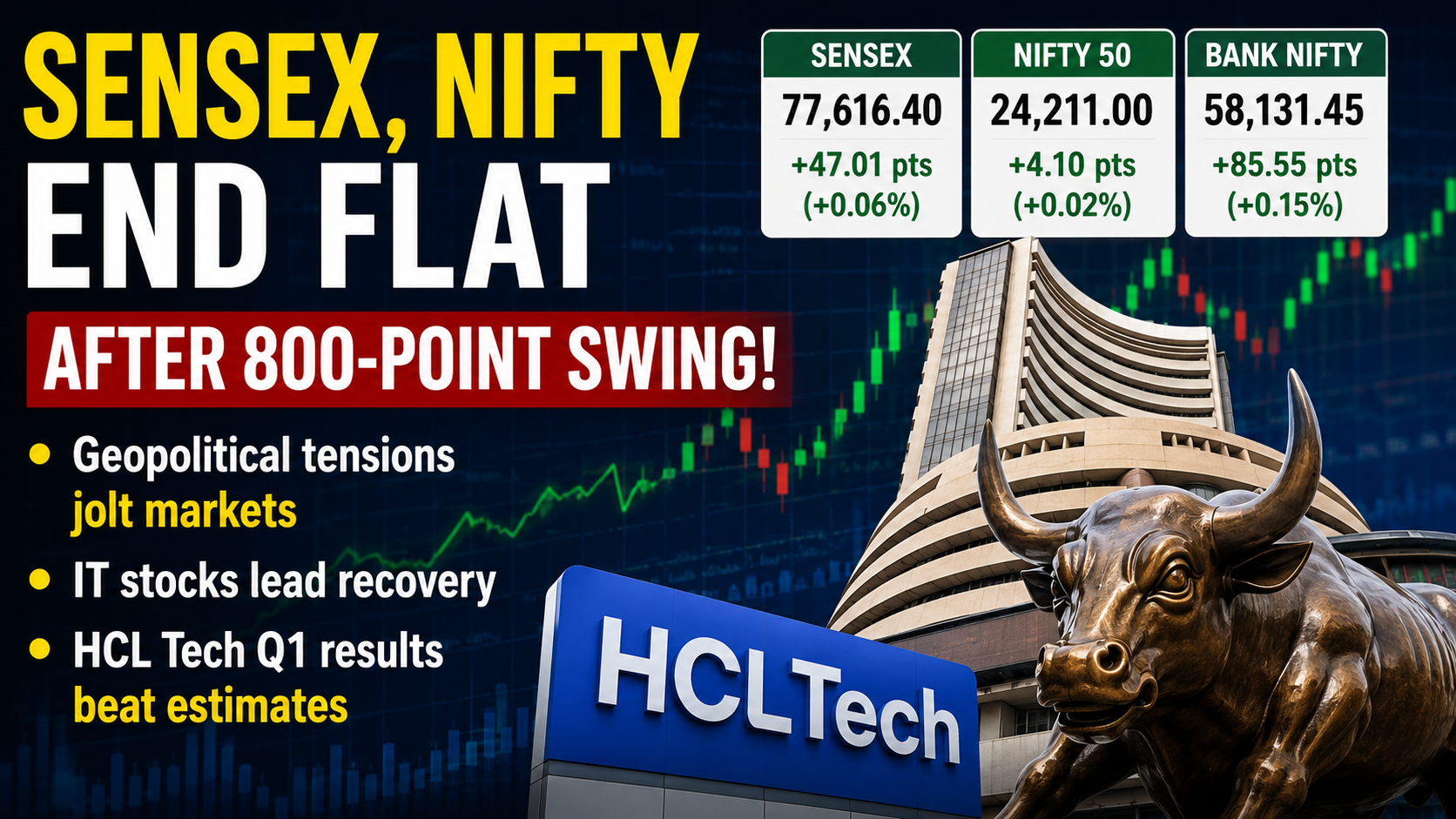
If you just glanced at the Sensex and Nifty closing numbers today, you’d think it was a boring session. It wasn’t. Under that flat headline number was one of the more dramatic intraday swings we’ve seen in a while — and a Q1 results story that’s still playing out. Here’s the full picture, broken down in plain English.
Market Snapshot: How Sensex and Nifty Closed Today
| Index | Close | Change | Day’s Range |
|---|---|---|---|
| Sensex | 77,616.40 | +47.01 pts (+0.06%) | 76,857.43 – 77,717.68 |
| Nifty 50 | 24,211.00 | +4.10 pts (+0.02%) | 24,000.20 – 24,247.10 |
| Bank Nifty | 58,131.45 | +85.55 pts (+0.15%) | — |
On paper, this looks like a non-event: Sensex up 47 points, Nifty up 4 points. But “marginally higher” is doing a lot of hiding here. Both indices opened with a sharp gap-down — the Sensex fell over 700 points at the open and the Nifty slipped below 24,000 — before clawing all the way back to end in positive territory.
For anyone new to market-watching: when a report says an index “held” a level like 24,200, it means that despite volatility during the day, the index managed to close above that psychological line — which traders often treat as a sentiment marker for whether the bulls or bears are in control.
Market breadth backed up the recovery story too: on the BSE, 2,341 shares advanced against 2,061 declines — a mildly positive sign that buying wasn’t limited to a handful of large-cap names.
Why Markets Opened Weak: US-Iran Tensions and the Strait of Hormuz
The morning’s selloff had nothing to do with earnings or economic data — it was geopolitics. Over the weekend, the US and Iran exchanged fresh missile and drone strikes, and Iran responded by announcing it would close the Strait of Hormuz.
Why does a strait halfway across the world move Indian stocks? Roughly 20% of the world’s oil shipments pass through the Strait of Hormuz. Any threat to that route sends oil traders into a panic, because it raises the odds of a genuine supply squeeze — not just a price spike based on fear.
And that’s exactly what happened: Brent crude jumped more than 4% intraday, trading near $79 a barrel before settling around $77.82. For India, which imports roughly 85% of its crude needs, pricier oil isn’t just a stock market problem — it feeds into the import bill, the fiscal deficit, and eventually inflation. That’s why markets react so sharply to oil-linked geopolitical news, even when the actual disruption hasn’t happened yet.
One more number worth knowing: India’s VIX — often called the market’s “fear gauge” — surged 8.38% to 13.28. VIX measures how much volatility traders expect over the near term. A rising VIX during a falling market usually means investors are paying up for protection (via options) because they expect more turbulence, not less.
How Markets Recovered: The Sensex’s 800-Point Round Trip
Here’s the part the closing number hides completely. The Sensex fell to an early low of 76,857.43, then rebounded over 800 points from that low to touch 77,717.68 in afternoon trade, before settling near 77,616.
What changed mid-session? Two things, really:
- Domestic buying interest stepped in where global sentiment had pulled back — a pattern that’s become fairly common in Indian markets over the past year, where foreign selling on geopolitical scares gets absorbed by domestic institutional and retail flows.
- IT stocks did the heavy lifting. As soon as buyers rotated into technology names, the drag from oil-and-defensive-sector selling eased, and the index climbed back toward flat.
So the “marginal gain” you see in the headline was really a tug-of-war between global risk-off sentiment and resilient domestic buying — and domestic buying won, barely.
HCL Tech Jumps 5% Ahead of Q1 Results: What Was Expected
While the broader market was fighting to stay flat, HCL Tech had its own storyline. Shares rallied nearly 5% intraday, settling around ₹1,221 ahead of its Q1 FY27 results, which were due after market hours the same day — a board meeting that would also decide on a second interim dividend for the year.
Going into the results, brokerage expectations were mixed:
- Most analysts expected revenue to rise roughly 13% year-on-year in rupee terms, helped along by a weaker rupee (currency depreciation makes dollar revenue look bigger in rupee terms).
- But on a constant-currency (CC) basis — which strips out the currency effect and shows the company’s actual underlying growth — the picture was murkier. ICICI Securities expected a 0.9% quarter-on-quarter CC decline, and Motilal Oswal (MOSL) pencilled in a 1.4% drop, pointing to discretionary spending cuts by US telecom clients and the discontinuation of a couple of SAP programs.
- Nuvama and Kotak Institutional Equities, meanwhile, expected HCL Tech to hold its FY27 guidance of 1.5–4.5% CC revenue growth and 17.5–18.5% operating margin.
- Analyst sentiment overall was lukewarm — a “Hold” consensus across 40 analysts, split roughly 30% Buy, 37.5% Hold, and 32.5% Sell.
In short: the market was betting the headline numbers would look good (thanks to the rupee), but the real test was whether the underlying business was actually growing — or just treading water.
HCL Tech Q1 FY27 Results: What Actually Came In
Here’s the update most live market blogs from today won’t have, because the results dropped after the closing bell. HCL Tech reported:
- Net profit: ₹4,624–4,626 crore, up about 20.3% year-on-year (from ₹3,843–3,844 crore a year ago) and up 3% sequentially from ₹4,490 crore in Q4 FY26.
- Revenue from operations: ₹34,579 crore, up nearly 14% year-on-year (from ₹30,349 crore) and up from ₹33,981 crore in the previous quarter.
- Interim dividend of ₹12 per share, with a record date of July 17, 2026, and payment date of July 27, 2026.
| Analyst Estimate | Actual Result | |
|---|---|---|
| Revenue growth (YoY) | ~13% | ~13.94% |
| Net profit growth (YoY) | ~15–17% | ~20.3% |
| CC revenue (QoQ) | Decline expected (-0.9% to -1.4%) | To be confirmed in management commentary |
The takeaway: HCL Tech didn’t just meet the rupee-revenue expectation, it beat the profit estimates most brokerages had pencilled in. Whether the constant-currency softness that ICICI Securities and MOSL flagged actually showed up — and whether FY27 guidance was maintained — will become clear once the management commentary from the post-results call is out. That’s the number to watch when markets open next: guidance commentary tends to move IT stocks more than the headline print itself.
Why IT Stocks Led the Rally While the Broader Market Stayed Flat
This is the real story of the day, and it’s easy to miss if you only read the index-level headline. The Nifty IT index surged 3.59% — its second big rally in two straight sessions, up 5.62% cumulatively. Within that:
- TCS rose 5.45%, after reporting a steady June quarter.
- HCL Tech climbed nearly 5%, ahead of its own results.
- Tech Mahindra (+3.35%), Infosys (+3.19%), Mphasis (+3.02%), Persistent Systems (+2.68%), and Coforge (+2.59%) also advanced.
Meanwhile, defensive and commodity-linked sectors — FMCG, Metal, Realty, Pharma, and Energy — were the day’s laggards, weighed down by the crude oil spike and general risk-off sentiment.
Why the split? Two forces were pulling in opposite directions on the same day. IT stocks benefited from rupee depreciation (a weaker rupee boosts dollar-earning exporters) plus genuine optimism around the ongoing Q1 earnings season. Oil-and-import-sensitive sectors, on the other hand, got hit directly by the crude price spike. That’s why the Sensex and Nifty could look almost unchanged while one sector rallied hard and others sold off — the gains and losses were largely cancelling each other out at the index level.
Top Gainers and Losers Today
Gainers:
- TCS, HCL Tech, Tech Mahindra, Infosys — IT majors rallying on rupee tailwinds and earnings optimism
- LTIMindtree (LTM) — up after reporting a 5.86% quarter-on-quarter jump in net profit to ₹1,468.6 crore on revenue of ₹11,608 crore
Losers:
- Tata Steel, Nestle, Eternal — among the day’s weakest performers as defensives and metals came under pressure
- HPCL (-2.46%), IOCL (-2.45%), BPCL (-1.68%) — oil marketing companies fell as crude prices spiked, since costlier crude squeezes their margins on regulated fuel pricing
Other Market Movers: Earnings, IPOs, and Data to Know
A few other developments from today are worth bookmarking:
- Fino Payments Bank surged on a strong June business update — total deposits up 11% to ₹2,755 crore, new account openings up 31% year-on-year to 3.1 lakh, and referral loan disbursals up a striking 253% year-on-year to nearly ₹240 crore, as the bank builds toward its planned transition into a small finance bank.
- Just Dial hit its upper circuit after reporting a 66.2% jump in net profit to ₹166.3 crore, with revenue up 9.9% year-on-year.
- L&T Finance rose after posting a 28.72% year-on-year jump in net profit to ₹902.47 crore.
- Millworks Technologies, a precision engineering company, opened its IPO for public subscription, aiming to raise ₹160.34 crore.
- India’s trade deficit widened to $30.43 billion in June 2026, up from $19.10 billion a year earlier and $28.21 billion in May — even though exports actually grew a healthy 15.5% to $40.41 billion. A widening trade deficit generally means India is paying more for imports (oil being the biggest culprit right now) than it’s earning from exports, which can put gradual pressure on the rupee over time.
What to Watch Tomorrow
Three things will likely set the tone for the next session:
- Further developments on the US-Iran conflict — particularly whether Iran follows through on any Strait of Hormuz restrictions, or whether tensions ease.
- Crude oil price direction — a pullback from $79/barrel would ease inflation worries; a further spike could reignite the selling seen at today’s open.
- HCL Tech’s post-results commentary — the stock’s reaction, and whether management confirms or trims FY27 guidance, will likely influence the whole IT pack, not just HCL Tech.
Also on the radar: the ongoing Q1 earnings season (more results are due through the week) and the progress of the southwest monsoon, which matters for rural demand and inflation expectations.
FAQs
What does it mean when Nifty “holds” a level like 24,200? It means that despite volatility during the trading session, the index still managed to close above that level. Traders often treat round numbers like 24,200 as psychological support — a level where buyers are expected to step in.
Why did HCL Tech shares jump before its results were announced? This is common ahead of earnings — traders position themselves based on expectations. In this case, brokerages were expecting solid rupee-term revenue growth (helped by a weaker rupee) and stable-to-improving margins, which built up buying interest even before the actual numbers were out.
What is constant currency (CC) growth in IT company results? It’s a company’s revenue growth after removing the effect of currency movements. Since Indian IT firms earn in dollars but report in rupees, a weaker rupee can make revenue growth look bigger than it really is. CC growth strips that out to show the actual underlying business performance.
Why do oil prices affect the Indian stock market so much? India imports the vast majority of its crude oil needs. When oil prices rise, it increases India’s import bill, puts pressure on the rupee, and can push up inflation — all of which make investors nervous about corporate earnings and interest rates.

