


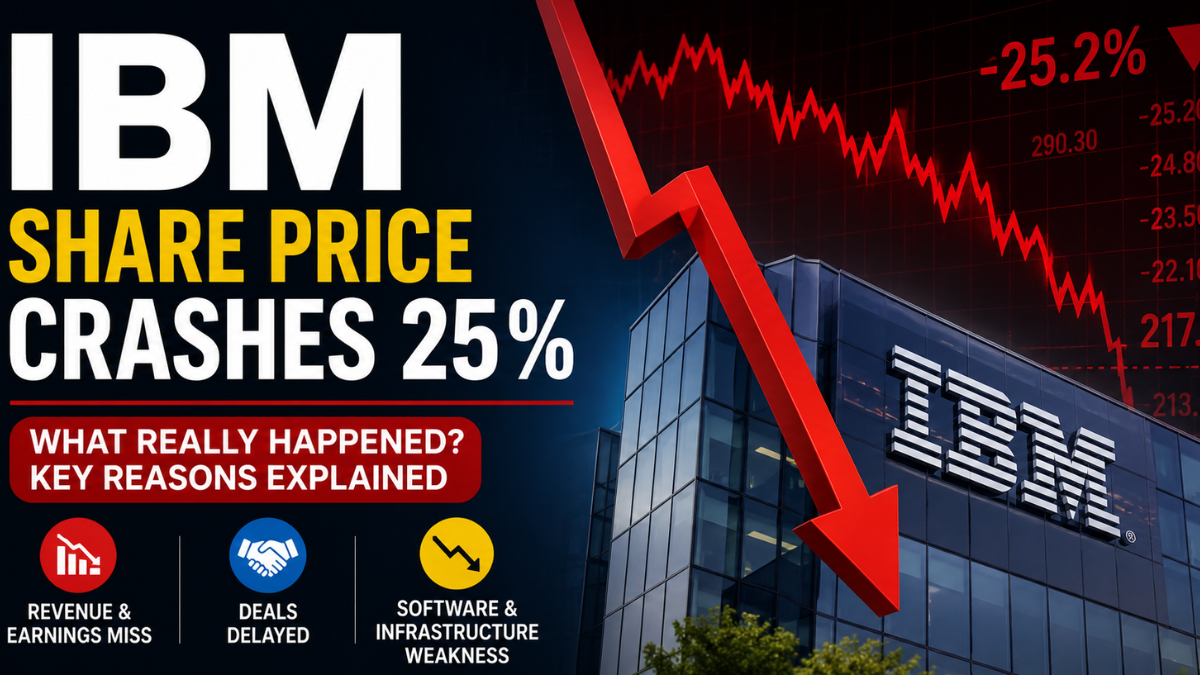
The IBM share price suffered a historic decline on July 14, 2026, after the technology company unexpectedly released preliminary second-quarter financial results that fell short of Wall Street’s expectations. IBM shares closed at approximately $217.07, falling around 25.2% in one trading session from the previous closing price of about $290.30.
For investors trying to understand whether this was a temporary market overreaction or evidence of a deeper business problem, the headline decline tells only part of the story. In this Gyan Mela analysis, we examine IBM’s preliminary numbers, the reasons given by management and the indicators investors should watch before drawing conclusions about the company’s future.
Key Takeaways
- IBM shares closed at about $217.07 on July 14, 2026, down approximately 25.2% for the day.
- The company expects second-quarter revenue of $17.2 billion, below the roughly $17.86 billion expected by analysts.
- Preliminary adjusted earnings were $2.93 per share, compared with an analyst estimate of approximately $3.01.
- IBM reported weaker-than-expected performance in its software and infrastructure businesses.
- Management said several large deals were not completed within the expected timelines.
- The numbers remain preliminary. IBM is scheduled to discuss its complete second-quarter results on July 22, 2026.
IBM Share Price: Latest Market Update
IBM’s stock closed at $217.07 on July 14, after trading as low as approximately $213.22 during the session. The decline erased around $69 billion from IBM’s market value and exceeded the company’s previous major one-day falls reported during periods such as the October 1987 market crash.
| IBM stock-market figure | July 14, 2026 update |
|---|---|
| Closing share price | Approximately $217.07 |
| Previous closing price | Approximately $290.30 |
| One-day decline | Approximately 25.2% |
| Intraday low | Approximately $213.22 |
| Estimated market value erased | About $69 billion |
The fall was particularly notable because it happened while the broader US market was relatively positive. The S&P 500 and Nasdaq Composite finished higher on the same day, indicating that IBM’s decline was primarily related to company-specific news rather than a broad technology-market crash.
Market prices can change when US trading resumes. The figures above refer to the latest completed session available when this article was checked on July 15, 2026.
What Triggered the 25% Fall in IBM Stock?
There was no single reason behind the crash. The market reacted to a combination of disappointing financial figures, lower segment growth, execution problems and uncertainty about corporate technology spending.
1. Revenue fell below market expectations
IBM reported preliminary second-quarter revenue of $17.2 billion, representing year-on-year growth of only 1%. Analysts surveyed by FactSet had expected approximately $17.86 billion. The difference of roughly $660 million was meaningful because investors had been pricing IBM as a company capable of maintaining stronger growth from software, artificial intelligence and enterprise infrastructure demand.
2. Adjusted earnings missed expectations
IBM’s preliminary operating or non-GAAP earnings came to $2.93 per share, up 5% from the comparable period but below the approximately $3.01 expected by analysts. GAAP diluted earnings were reported at $2.27 per share, down 2%.
This distinction matters. IBM did not report a quarterly loss. The problem was that its earnings and revenue were weaker than the market had expected, causing investors to reconsider the growth assumptions built into the share price.
3. Software growth slowed sharply
IBM’s software business is central to its long-term transformation because software generally provides recurring revenue and higher margins. Preliminary software revenue increased by 5%, while investors had expected stronger expansion.
That result was particularly disappointing after IBM reported an 11% increase in software revenue during the first quarter of 2026. The sudden slowdown raised questions about whether customers were delaying software purchases or redirecting technology budgets toward more immediate infrastructure requirements.
4. Infrastructure revenue declined 7%
IBM’s infrastructure revenue fell by 7%. Management said performance from the IBM Z business and the related software stack, especially transaction-processing products, was worse than the company had anticipated.
IBM had expected some decline as the company moved beyond the initial launch period for its z17 mainframe. However, the actual weakness was greater than expected, making the decline harder for investors to dismiss as a normal product-cycle effect.
5. Customers redirected capital spending
IBM said some clients shifted their quarterly capital expenditure toward servers, storage systems and memory products. Customers were reportedly trying to secure supply-constrained equipment before possible price increases.
That shift affected the timing of software and mainframe-related purchasing decisions. Management had anticipated some pressure from supply-chain conditions but underestimated the scale of the spending reprioritisation.
Here is the practical impact: a company may still have a strong long-term technology budget, but when a large portion of that budget is suddenly redirected toward hardware, planned software contracts can be delayed.
6. Several large deals did not close on time
Management acknowledged that IBM did not adjust quickly enough to changing customer behaviour. Several major transactions that the company expected to complete during the quarter were delayed, accounting for much of the performance shortfall.
This part matters because delayed deals can have two very different meanings. The revenue may simply move into a later quarter, or the delays may reveal weaker customer demand and more difficult sales conditions. Investors will need additional information from IBM’s full earnings announcement before knowing which interpretation is more accurate.
7. The unexpected early announcement increased uncertainty
IBM had previously scheduled its second-quarter earnings call for July 22, 2026. Instead, the company released selected preliminary results on July 14, more than a week before the scheduled discussion.
The unusual timing likely intensified the market reaction. An early preliminary release can signal that management believes investors need to be informed about a material difference between previous expectations and actual performance.
IBM’s Preliminary Q2 2026 Results at a Glance
| Financial measure | Preliminary result | Year-on-year movement |
|---|---|---|
| Total revenue | $17.2 billion | Up 1% |
| Software revenue | Not separately disclosed | Up 5% |
| Consulting revenue | Not separately disclosed | Flat; up 1% at constant currency |
| Infrastructure revenue | Not separately disclosed | Down 7% |
| GAAP diluted EPS | $2.27 | Down 2% |
| Operating non-GAAP EPS | $2.93 | Up 5% |
| Year-to-date operating cash flow | $7.8 billion | Not specified |
| Year-to-date free cash flow | $4.8 billion | Not specified |
These figures are preliminary and could change slightly when IBM closes its financial reporting process.
Was Everything in IBM’s Business Weak?
No. The preliminary announcement also contained areas of strength that were overshadowed by the headline earnings miss.
- Red Hat revenue grew 11%, accelerating from the preceding quarter.
- Recent acquisitions, including HashiCorp and Confluent, reportedly performed strongly.
- Distributed Infrastructure revenue increased 37%, supported by Power and Storage demand.
- The Distributed Infrastructure backlog was approximately $500 million at the end of the quarter.
- The z17 programme remained ahead of the comparable z16 programme, despite the quarterly shortfall.
- IBM reported continued growth in consulting signings, helped by generative-AI-related work.
These positive figures show why the investment case is not as simple as saying that IBM’s entire business has collapsed. The bigger question is whether the stronger product areas can offset slower software growth, deal delays and changing customer spending patterns.
Why Did a Moderate Earnings Miss Cause Such a Large Crash?
A 25% stock decline may appear disproportionate when revenue still grew and IBM remained profitable. The size of the reaction can be understood through market expectations.
Before the announcement, investors were assigning considerable value to IBM’s software transformation, Red Hat portfolio, enterprise AI opportunity and mainframe cycle. When a stock price reflects strong expectations, even a moderate earnings disappointment can lead to a major valuation reset.
The market was not responding only to one quarter’s revenue difference. Investors were also reconsidering:
- Whether software growth can return to double-digit levels
- Whether delayed contracts will close in later quarters
- Whether enterprise IT budgets are moving away from IBM’s most profitable products
- Whether infrastructure weakness is temporary or part of a broader trend
- Whether IBM will revise its full-year revenue or free-cash-flow expectations
- Whether the company can execute consistently during rapid changes in AI and hardware spending
What Investors Should Watch Next
IBM’s complete results on July 22
IBM is scheduled to discuss its full second-quarter results on July 22, 2026, at 5:00 p.m. Eastern Time. The complete announcement should provide more detailed segment figures, management commentary and updated full-year expectations.
Full-year guidance
The most important question is whether IBM changes its forecasts for revenue growth and free cash flow. A quarterly miss becomes more serious when management also lowers its expectations for the complete financial year.
Delayed large deals
Investors should look for evidence that contracts delayed in June are closing during the third quarter. A recovery in deal completion would support the argument that the Q2 weakness was partly caused by timing.
Software and Red Hat growth
Software is a major part of IBM’s long-term strategy. Red Hat’s 11% growth was encouraging, but investors will want to know whether the wider software portfolio can regain momentum.
Profit margins and free cash flow
Despite lower revenue growth, IBM reported an operating pre-tax margin of 19.2%, up 30 basis points. Investors should examine whether productivity savings can continue supporting margins without weakening future product development or sales execution.
Enterprise spending priorities
The company’s explanation suggests that some businesses are prioritising servers, storage and memory purchases over other technology projects. If that trend continues, it could influence IBM as well as consulting and enterprise-software companies more broadly.
Should Investors Buy IBM Stock After the Fall?
A large one-day decline does not automatically make a stock undervalued. The lower share price must be compared with the company’s updated revenue prospects, earnings quality, cash flow and business risks.
Investors considering IBM after the crash may want to assess:
- Whether the full-year outlook is maintained or reduced
- Whether software growth rebounds after the second quarter
- Whether delayed contracts are eventually completed
- Whether the new valuation adequately reflects slower growth
- Whether IBM’s dividend and free cash flow remain sustainable
- Whether the investment fits their risk tolerance and portfolio allocation
That sounds straightforward, but there is another side. Investors who buy immediately after a sharp fall face the risk of further volatility when IBM publishes its complete results. Waiting for additional information may reduce uncertainty, although it does not remove market risk.
Gyan Mela does not recommend buying or selling IBM shares based only on a single trading session. A sensible decision requires examining the complete financial results, management guidance, valuation and individual investment objectives.
What the IBM Share Price Fall Means for Indian Investors
IBM is listed on the New York Stock Exchange under the ticker IBM. It is not directly listed on the NSE or BSE. Indian investors accessing IBM through an international-investing platform should remember that their final return can be affected by more than the movement in the US share price.
Important considerations include:
- Changes in the US dollar–Indian rupee exchange rate
- Brokerage and foreign-exchange conversion charges
- Overseas remittance requirements
- Indian taxation of foreign dividends and capital gains
- US dividend withholding
- Differences between US and Indian market timings
- Additional volatility around earnings announcements
Investors should verify the latest platform charges, tax rules and overseas-investment conditions before placing a transaction.
Frequently Asked Questions
What was the IBM share price after the crash?
IBM shares closed at approximately $217.07 on July 14, 2026. The stock fell by about 25.2% from its previous closing price of approximately $290.30. Prices may change when the US market opens for the next trading session.
Why did the IBM share price fall by 25%?
The decline followed preliminary second-quarter results that missed analyst expectations. IBM reported slower software growth, a 7% fall in infrastructure revenue, weaker IBM Z performance and delays in completing several large deals. Management also said some customers redirected spending toward servers, storage and memory products.
Did IBM report a financial loss?
No. IBM remained profitable in its preliminary Q2 update. The company reported GAAP diluted earnings of $2.27 per share and adjusted operating earnings of $2.93 per share. The market reacted because revenue and adjusted earnings were lower than analysts had expected, not because IBM reported an overall quarterly loss.
Was this IBM’s worst one-day stock decline?
Market data providers described the July 14 fall as IBM’s largest one-day percentage decline on record, surpassing the approximately 23.7% drop recorded during the Black Monday market crash on October 19, 1987. Historical descriptions can vary depending on the starting date and adjustment method used by each data provider.
When will IBM release its complete Q2 2026 results?
IBM is scheduled to hold its full second-quarter earnings announcement and investor conference call on July 22, 2026, at 5:00 p.m. Eastern Time. The company is expected to provide more detailed financial statements and discuss its full-year outlook during that event.
Is IBM stock now undervalued?
A lower price alone does not confirm that a stock is undervalued. Investors must compare IBM’s market value with its expected earnings, free cash flow, debt, software growth and future guidance. The company’s complete Q2 results will provide more information for evaluating whether the decline represents excessive pessimism or a justified valuation reset.
Can Indian investors purchase IBM shares?
Indian residents may access certain US-listed shares through brokers and investment platforms that support overseas investing. IBM trades in US dollars on the New York Stock Exchange. Investors should check the platform’s eligibility rules, currency-conversion costs, remittance requirements and applicable Indian tax obligations before investing.
Conclusion
The IBM share price crash reflects more than a disappointing quarterly number. Investors are questioning whether changing enterprise spending priorities, weaker infrastructure performance and delayed software deals could slow IBM’s transformation.
At the same time, Red Hat growth, strong Distributed Infrastructure demand and positive consulting signings suggest that IBM continues to have valuable business segments. The decisive information will come from the complete Q2 results, management’s full-year guidance and evidence about whether delayed contracts are eventually completed.
The most sensible next step is to avoid reacting only to the size of the decline. Readers should examine the updated fundamentals and consider their own risk tolerance. Gyan Mela will continue to focus on verified figures and balanced analysis rather than predicting a guaranteed recovery or further fall.
Disclaimer: This article is intended for general informational and educational purposes only. It should not be treated as personalised investment or financial advice, or as a recommendation to buy, hold or sell IBM shares. Stock prices, exchange rates, financial results and market conditions may change rapidly. Readers should verify the latest information from IBM, the relevant stock exchange and regulatory sources and consult a qualified financial professional where necessary.
Author: Gyan Mela Editorial Team

