


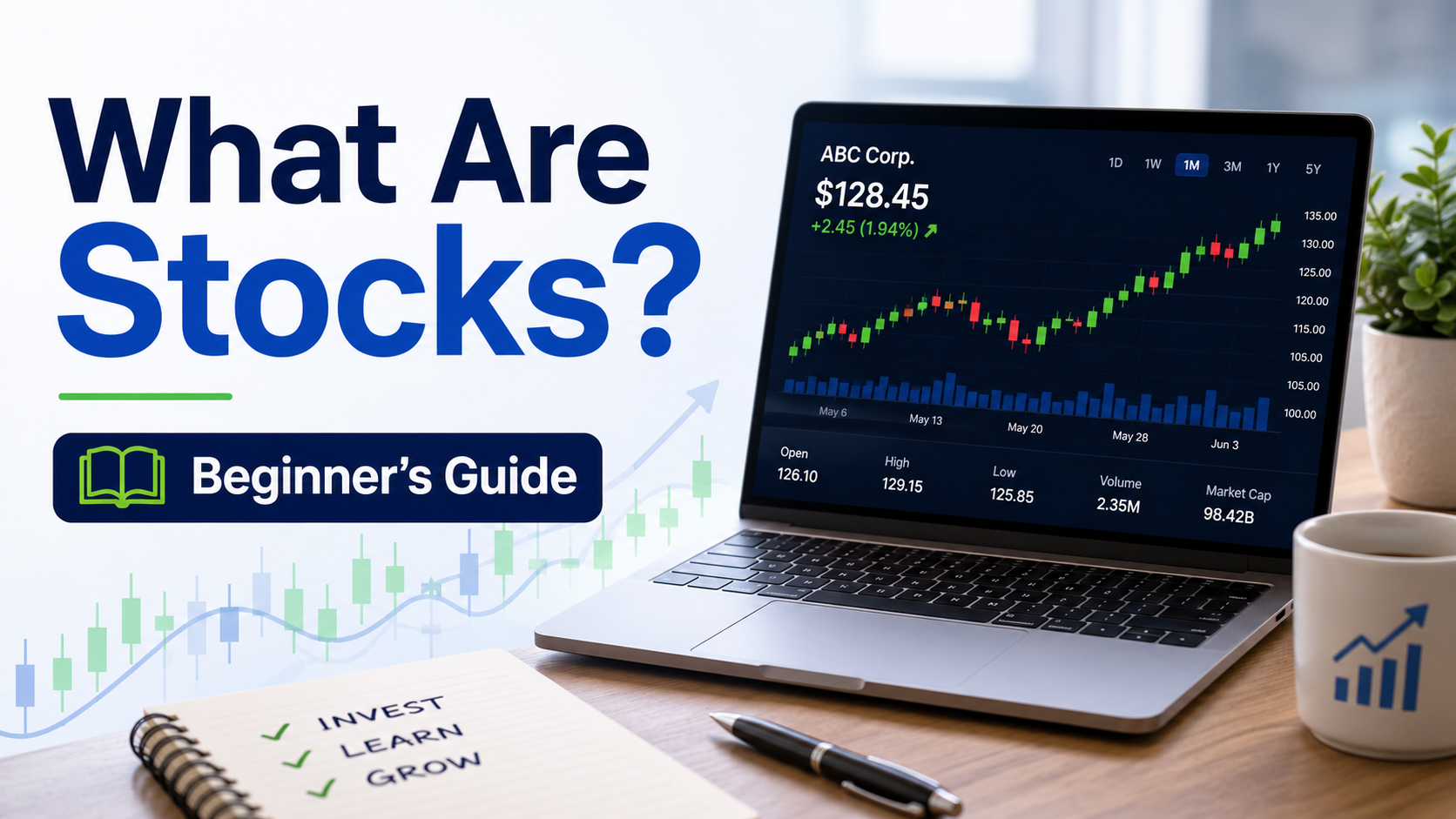
If you’ve ever heard someone say “the market was up today” and wondered what that actually means for your money, you’re not alone. Most people start investing without ever getting a straight answer to a basic question: what exactly is a stock?
This guide answers that — no jargon, no assumption that you already know what a “bid-ask spread” is. By the end, you’ll understand what you’re actually buying when you buy a stock, how people make (and lose) money doing it, and how to place your first trade if you decide you’re ready.
What Is a Stock?
A stock is a small piece of ownership in a company. When you buy one share of a company, you’re not lending it money — you’re buying a literal slice of that business.
Think about it like a pizza. If a company splits itself into 1,000 slices (shares) and you buy one, you own 0.1% of that company. If the company does well and grows in value, your slice is worth more. If it struggles, your slice is worth less. You share in the outcome, good or bad.
Here’s a real example: Apple has roughly 15 billion shares outstanding. If you buy one share, you own a tiny fraction of Apple — but you’re still a part-owner, with the same basic rights as Tim Cook’s largest institutional shareholders, just at a much smaller scale. You can vote on certain company matters (like electing the board of directors), and if Apple pays a dividend, you get your cut.
One quick vocabulary note: “stock,” “share,” and “equity” get used interchangeably, and that’s fine. “Stock” usually refers to ownership in a company generally (“I own Apple stock”), while “share” refers to a specific unit of that ownership (“I own 10 shares”). “Equity” is the more formal financial term for the same thing.
How Do Stocks Work?
Stock prices move constantly, and the reason is simpler than it looks: price is just what someone else is willing to pay right now. It’s supply and demand, playing out in real time.
If more people want to buy a stock than sell it, the price goes up. If more people want to sell than buy, it goes down. What drives that demand? A mix of things — company earnings, industry news, interest rate changes, competitor announcements, even a CEO’s tweet. Markets are, in large part, a reflection of what millions of people collectively believe a company is worth right now, which is why prices can swing on news that has nothing to do with a company’s actual day-to-day operations.
There are two markets worth knowing about:
- The primary market is where a company sells shares for the first time, through an Initial Public Offering (IPO). This is how the company raises money directly.
- The secondary market is where the rest of us trade — buying and selling existing shares between investors on exchanges like the New York Stock Exchange (NYSE) or the Nasdaq. When you “buy Tesla stock,” you’re not giving Tesla your money; you’re buying an existing share from another investor who’s selling.
When you place an order, you’ll usually choose between two types:
- Market order: buy or sell immediately at the current price.
- Limit order: buy or sell only if the price hits a specific number you set.
If you’re just starting out, market orders are simpler and fine for most situations. Limit orders become more useful once you’re trying to buy or sell at a very specific price point.
Why Do Companies Issue Stock?
Companies sell stock because it’s a way to raise large amounts of money without taking on debt. Instead of borrowing from a bank and owing interest, a company sells ownership stakes to investors. The trade-off: those investors now own a piece of the company and share in its future profits (or losses).
This is exactly what happens during an IPO. Take SpaceX, which went public via an IPO in mid-2026. Before that, the only way to own a piece of SpaceX was through private investment rounds available to institutions and accredited investors. Once it IPO’d, everyday investors could buy shares on the open market for the first time — and SpaceX walked away with a large capital raise it can use to fund operations, expansion, or debt repayment.
Companies also use stock to pay employees, especially in tech. Stock options and restricted stock units (RSUs) let companies compensate people without depleting cash reserves, while giving employees a direct incentive to help the company succeed.
Types of Stocks
Not all stocks behave the same way, and understanding the categories helps you make sense of what you’re buying.
Common stock vs. preferred stock. Common stock is what most people buy — it comes with voting rights and the potential for the stock price to grow, but dividends aren’t guaranteed. Preferred stock typically pays a fixed dividend and gets priority if a company goes bankrupt, but usually comes without voting rights. Most beginner investors own common stock.
Growth stocks vs. value stocks. Growth stocks (think Nvidia or Tesla in their earlier years) reinvest profits into expanding rather than paying dividends — investors buy them expecting the share price to rise significantly over time. Value stocks are companies trading for less than what their fundamentals suggest they’re worth — often more established, stable businesses that the market has temporarily undervalued.
Market cap: large-cap, mid-cap, small-cap. This refers to a company’s total value (share price × number of shares). Large-cap companies (like Microsoft or Johnson & Johnson) tend to be more stable and established. Small-cap companies carry more risk but also more room for growth.
Dividend stocks vs. non-dividend stocks. Some companies, especially mature ones like Coca-Cola or Procter & Gamble, pay shareholders a portion of profits regularly (a dividend), which is a way to earn income even if the stock price doesn’t move much. Younger or high-growth companies often skip dividends entirely, reinvesting everything back into the business.
Domestic vs. international stocks. Domestic stocks are companies based in your home country. International stocks give you exposure to other economies, but come with added complexity: currency risk, different regulations, and less familiar company reporting standards.
How Do You Make Money from Stocks?
There are really only two ways:
Capital appreciation — you buy a stock at one price and sell it later at a higher price. This is the mechanism most people think of when they picture investing. If you’d bought Amazon stock in 2001 for a few dollars a share, you’d have seen extraordinary appreciation over the following two decades.
Dividends — some companies distribute a portion of their profits to shareholders on a regular basis (often quarterly), simply for holding the stock. You don’t need to sell anything to get this income; it shows up as cash (or additional shares, if reinvested) on a schedule.
Here’s the part beginner-focused content often glosses over: stocks aren’t guaranteed to go up. You can lose money, including losing your entire investment if a company fails. That’s the trade-off for the higher potential returns stocks offer compared to safer assets like savings accounts or government bonds. Nobody — not analysts, not fund managers, not financial news anchors — can reliably predict short-term price movements. That uncertainty is the price of admission.
How to Start Buying Stocks (Step-by-Step)
1. Open a brokerage account. This is the account that lets you buy and sell stocks. Options range from full-service brokers to app-based platforms, most of which now offer commission-free trading on stocks.
2. Decide how much to invest. A good rule of thumb: only invest money you won’t need in the next few years, and never money you can’t afford to lose. Many brokerages now let you buy fractional shares, so you don’t need hundreds of dollars to buy into an expensive stock like Nvidia or Apple — you can start with as little as $5 or $10.
3. Research before you buy. At minimum, understand what the company does, how it makes money, and why you believe it’ll be worth more in the future. Look at recent earnings reports and how the stock has performed over multiple years, not just the last few weeks.
4. Place your order. Enter the stock’s ticker symbol (like AAPL for Apple), choose how many shares (or dollar amount, if fractional shares are supported), pick market or limit order, and confirm.
5. Think about diversification early. Buying one or two individual stocks concentrates your risk in those specific companies. Many beginners start with index funds or ETFs (which we cover below) to spread risk across dozens or hundreds of companies, then add individual stocks as they get more comfortable.
Stocks vs. Other Investments
Stocks vs. bonds. When you buy a bond, you’re lending money to a company or government in exchange for interest payments — you’re a creditor, not an owner. Bonds are generally lower-risk and lower-return than stocks. Stocks offer higher long-term growth potential but with more volatility along the way.
Stocks vs. mutual funds/ETFs. A mutual fund or ETF (exchange-traded fund) pools money from many investors to buy a basket of stocks (or other assets) at once. Instead of picking individual companies, you’re buying instant diversification. An S&P 500 ETF, for example, gives you exposure to 500 of the largest U.S. companies in a single purchase — a common starting point for beginners who want stock market exposure without picking individual winners.
Stocks vs. real estate. Real estate requires far more capital upfront and is much less liquid — you can’t sell a portion of your house in five seconds the way you can sell a stock. Stocks offer easier entry, more flexibility, and easier diversification, though real estate can offer benefits like rental income and certain tax advantages that stocks don’t.
Common Risks and Mistakes Beginners Should Know
Emotional investing. Panic-selling during a downturn and euphoria-buying during a rally are two of the most common ways beginners lose money. Markets go through cycles — a well-known one being the sharp AI-driven chip stock swings that have rattled indexes like the Nasdaq in recent years. Reacting emotionally to short-term volatility often locks in losses that would have recovered with patience.
Putting everything into one stock. It’s tempting to go all-in on a company you believe in, but concentration means one bad earnings report or piece of news can wipe out a big chunk of your portfolio. Diversifying across sectors and company sizes reduces that single-company risk.
Trying to time the market. Waiting for the “perfect” moment to buy or sell is a losing game even for professionals. Historically, staying invested consistently over time (rather than jumping in and out) has outperformed most attempts to predict short-term moves.
Ignoring fees and taxes. Trading commissions have mostly disappeared, but taxes haven’t. Selling a stock for a profit within a year of buying it is usually taxed at a higher short-term capital gains rate than holding it for more than a year. Understanding this before you sell can save you real money.
FAQs
Is it a good time to buy stocks?
There’s no universally “right” time — markets fluctuate constantly based on countless factors. Rather than trying to time entry perfectly, most long-term investors focus on consistent investing over time (a strategy called dollar-cost averaging) rather than waiting for a specific market condition.
How much money do I need to start investing in stocks?
Thanks to fractional shares, you can start with as little as a few dollars on most modern brokerage platforms. There’s no minimum required to begin learning how investing works.
Can you lose more than you invest in stocks?
If you simply buy shares outright (rather than using borrowed money, known as margin, or complex instruments like options), the most you can lose is what you put in — the stock’s value can go to zero, but not below it.
What’s the difference between stocks and shares?
“Stock” refers to ownership in a company broadly; “shares” are the individual units that make up that ownership. You’d say “I own Tesla stock” or “I own 20 shares of Tesla” — both describe the same thing at different levels of specificity.

